

Case StudyAI-Assisted Backend Boundary
A lightweight backend shim, built within a two-week transition window, that moved Snowflake query logic out of the front-end, reduced coupling, and showed how AI-assisted development can move faster when bounded by clear engineering judgment.
Focus: using AI-assisted development without letting raw data access, security assumptions, or backend logic leak into the front-end.
Role
Front-End Architect · 2026, 2-week implementation window
Challenges
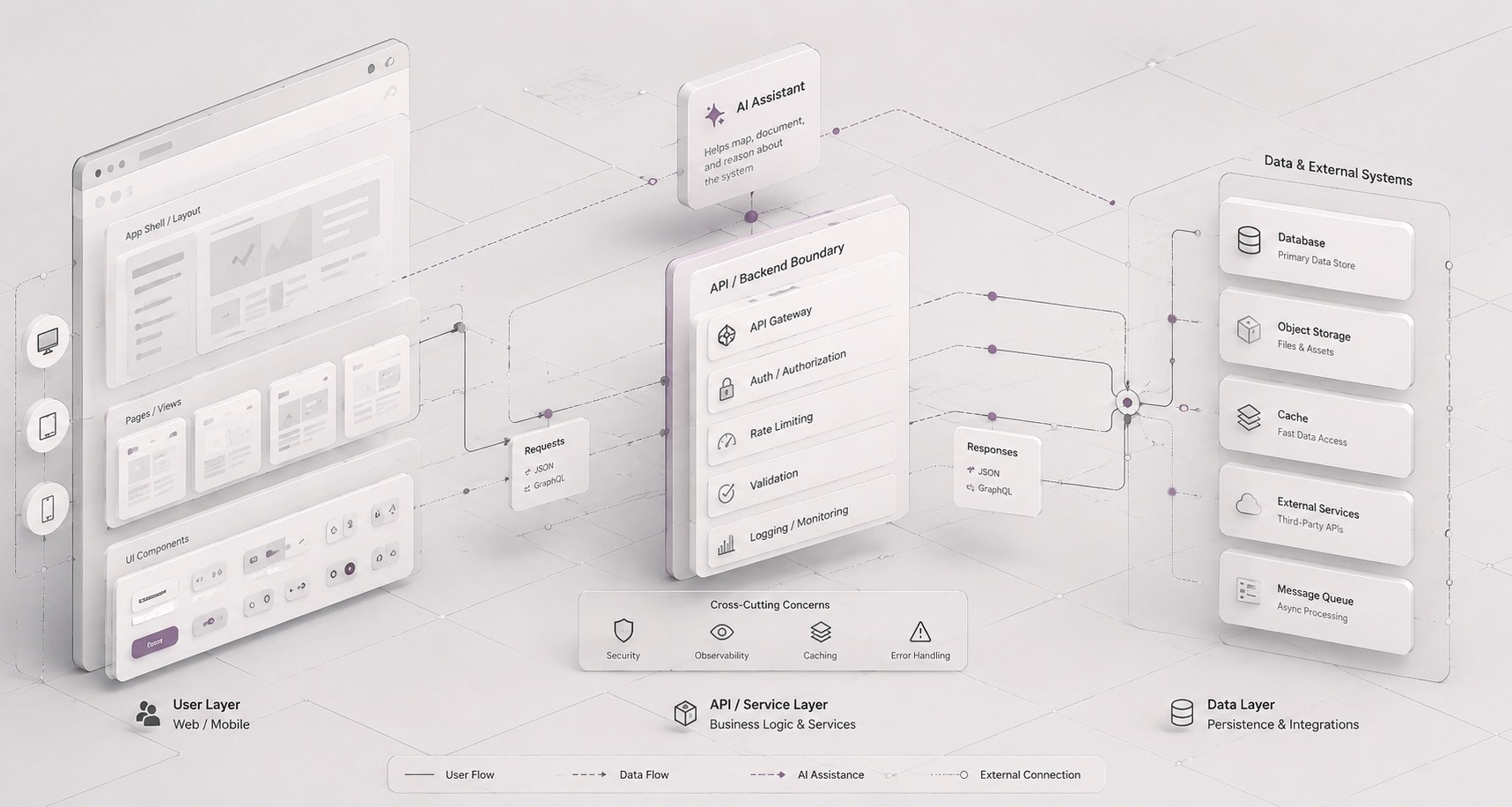
The initial implementation path risked placing a large, frequently changing Snowflake SQL query too close to the front-end workflow. That would have made front-end files responsible for data-access logic, made SQL changes harder to isolate and review, and increased the chance that AI-generated edits could quietly reshape backend behavior through UI code.
The goal was not to build a full backend platform. It was to create just enough backend boundary to keep the UI clean, isolate the data layer, and make the implementation understandable for future developers.
Process & Solution
I reframed the proof of concept around a simple backend boundary instead of allowing the front-end to own Snowflake access directly. The implementation used a lightweight Node/Express API shim to separate UI behavior from data access, with the backend organized around routes, endpoint handlers, query modules, and environment configuration.
AI coding assistants were useful for scaffolding, repetitive refactoring, and implementation cleanup, but the architectural decisions stayed human-owned: where the boundary belonged, what logic should not live in the UI, and how the work should be organized for future developers.
The guiding rule was simple: no raw SQL in front-end code. That rule kept the proof of concept small while still leaving room for a more formal API layer later.
Outcome
The proof of concept created a cleaner separation between UI behavior and Snowflake-backed data access. It gave the team a safer way to iterate without embedding raw SQL, security assumptions, or AI-shaped backend logic directly into front-end code.
More importantly, it established a reusable implementation pattern: move fast with AI where it helps, but protect the architectural boundaries that make the system maintainable.
Technologies & Tools
- Front-end React, Vite
- Backend Boundary Node.js, Express, REST API
- Data Layer Snowflake, environment configuration
- Validation & Workflow Postman, GitHub, Docker
- AI Assistance GitHub Copilot with OpenAI and Anthropic models